- The Daily Brief, by The Kenyan Wall Street
- Posts
- The Revolt at WPP Scangroup
The Revolt at WPP Scangroup
Kenya's #1 newsletter among business leaders & policy makers

Register here »»»»»
Good evening. It’s Brian from The Kenyan Wall Street.
After another year of loss, WPP Scangroup is about to face another corporate showdown as the sidelined founder and CEO prepares to mobilize minority shareholders into ousting the board. Achieving this would be a vaulted task, but it could worsen the advertiser’s performance on the stock market.
This and more stories in today’s newsletter…
The Revolt at WPP Scangroup

Founder and former CEO WPP Scangroup Bharat Thakrar
By Harry Njuguna
Bharat Thakrar, the founder who built WPP Scangroup from a one-man agency into a listed firm, is attempting to wrest back control by leading a minority shareholder push to remove the company’s entire board. The group, which controls 13.59% of shares, has formally requisitioned a meeting to oust all nine directors, targeting leadership it blames for years of decline. The move is unlikely to succeed against majority owner WPP Plc, which holds about 50.1%, but it lays bare the deep fractures in the advertising company over strategy, governance and performance. At the center of the dispute are roughly KSh 3.1 billion in cumulative losses, a steep revenue collapse and a share price that has fallen more than 60% since Thakrar’s exit. Even in defeat, the campaign forces a public confrontation over who controls the company, and whose interests the board ultimately serves.
Read the article here >>>>>
Why Your Next Big Deal Isn’t Happening in a Boardroom but in Kigali This May

By Fred Obura
In an era where global capital is fragmenting and competition for investment is intensifying, forums like the Africa CEO Forum are no longer talk shops; they are transaction platforms. Beneath the headline panels and high-level dialogue lies a structured marketplace for deals, where capital meets bankable projects, and conversations are engineered to convert into commitments. Set to be held in Kigali, the 2026 edition reflects a broader shift in how Africa is positioning itself by moving from a recipient of capital to a co-creator of scalable, cross-border investments. The theme of shared ownership is not rhetorical, it is financial architecture and the organizing logic behind the forum’s dealmaking pipeline.
Read the full article here »»»»»
NSE Week 20 Analysis : Safaricom’s Rally, Banks Disappoint
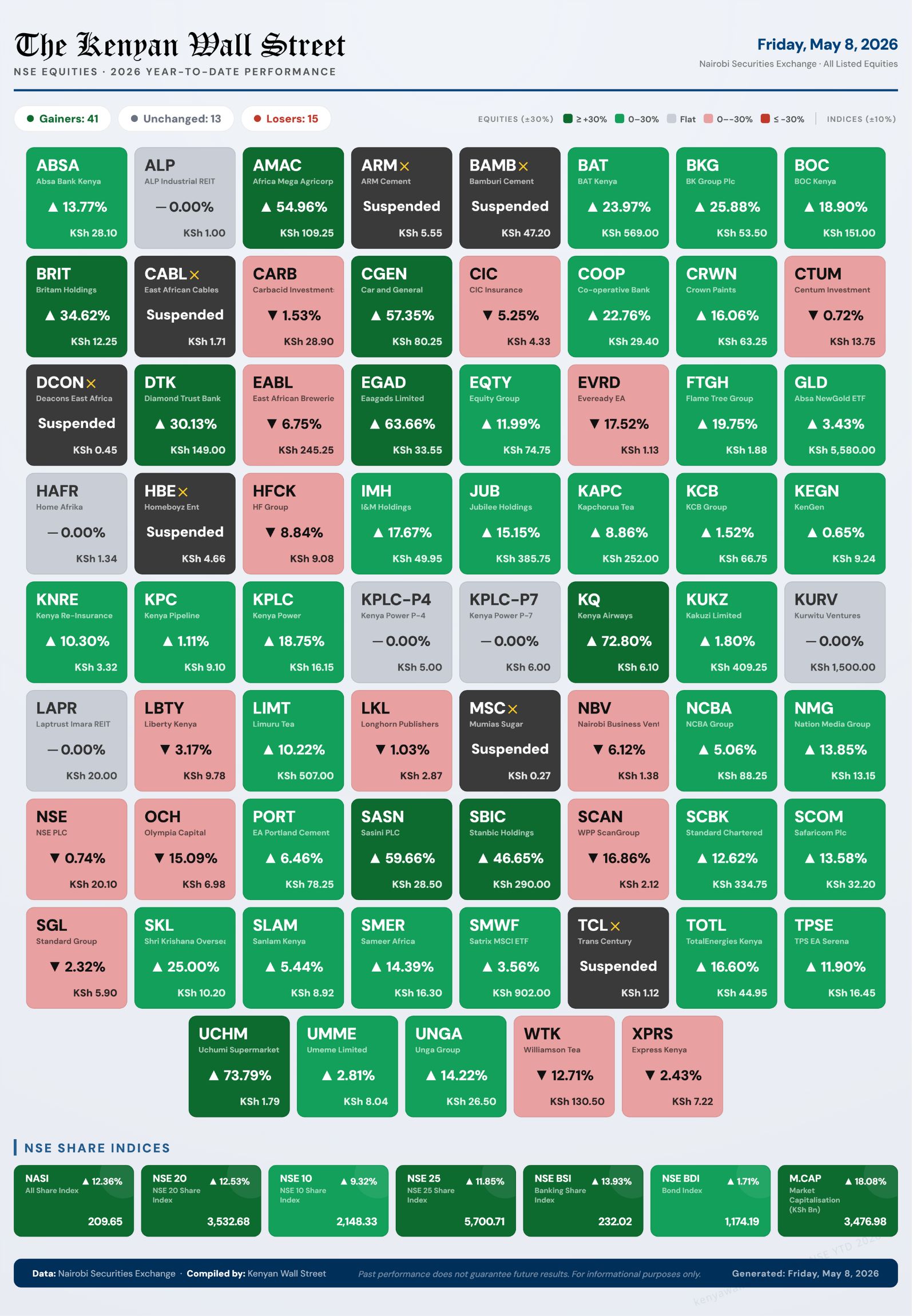
How equities performed at the NSE last week
By Harry Njuguna
Safaricom shares surged 8.4% to KSh 32.20 after the telecom reported a record KSh 95.61 billion profit and declared a historic KSh 80.13 billion dividend, lifting the broader market. The rally pushed the NSE All Share Index up 2.1% and added roughly KSh 100 billion in market value in a single session, masking underlying weakness across equities. Banking stocks declined sharply, with ABSA Bank Kenya, Co-operative Bank of Kenya, and KCB Group all posting losses, dragging the Banking Index down 1.74%. Meanwhile, foreign investors turned net sellers while Treasury bill rates edged higher, even as falling oil prices and stronger foreign exchange reserves eased some macroeconomic pressure.
Read the full analysis here >>>>>
Safaricom’s Costly Copyright Breach

By Brian Nzomo
Safaricom has been ordered to pay KSh 1.4 billion and ongoing royalties after the High Court found it copied key elements of a parental-control feature embedded in M-PESA. The dispute with Peter Nthei Muoki and his firm Beluga turned on a narrow legal line: the idea of a youth wallet was free to use, but the detailed execution was not. The court ruled Safaricom had access to the material and failed to prove it built the product independently, pointing to inconsistencies in its development record. Rather than shut down the widely used feature, the judge tied compensation directly to M-PESA’s scale, awarding a 1% revenue-based payout and a continuing 0.5% royalty.
Read the details of the case here »»»»»
Heads Up


Why Fleet Owners Are Turning to Smart Monitoring Systems

By Terry Gathoni
Rising fuel costs and persistent losses from theft and inefficiency are pushing Kenyan fleet operators toward real-time monitoring systems to protect margins. Businesses are deploying tools such as fuel sensors, GPS tracking, and analytics dashboards to detect siphoning, track consumption and flag irregular patterns. The shift reduces reliance on manual reporting while improving accountability, route efficiency and driver behaviour across large fleets. With pump prices remaining elevated, companies are turning to data-driven oversight not as an upgrade, but as a necessity to control one of their largest operating costs.
Read the opinion article here >>>>>
What You Should Watch!

For timely and insightful market updates, follow our Whatsapp channel here
Keep up with what’s happening on our X and LinkedIn pages. Stay updated with the latest financial news on our website The Kenyan Wall Street.